

Economic life in Malta in the 18th century
Published on 06/02/2011Aurore VERIÉ
I discovered an aspect of the economic life of the Maltese in the 18th century by reading "Corsairing to Commerce" by Carmel Vassallo. I have written this summary for you.
During the 16th and 17th centuries, approximately 4,000 men earned their living through trade with the Maghreb and Sicily and, alongside this activity, and to protect it, they fought against piracy by being pirates themselves. When France and Turkey concluded peace agreements and, as a result, the Mediterranean became less dangerous, these men converted to trade with countries in the North and West of the Mediterranean basin. They became merchant sailors or, better yet, travelling merchants.
From Sicily to the western coast of Italy, they went from port to port, reached Marseille and from there, sailed to Spain which was their final destination. Some, like Paolo Farrugia and Marcello Mallia, pushed on to Portugal and a few ventured as far as the Caribbean and Vera Cruz.
They sailed along the coasts to quickly find refuge in case of storms but also to avoid unwelcome encounters. Contrary to Mediterranean tradition, they departed in the bad season when pirates stay warm at home. They left in convoys from La Valette and each ship in the convoy was a family enterprise where brothers, cousins, uncles and nephews, fathers and sons were associated. No written contracts. Before departure, they agreed on the percentage of profits that would go to each person, on covering the costs of illness – except venereal diseases – and everything was based on one's given word. Crews were recruited from Cospicua and Senglea as well as from Zabbar, Zurrieq and Zejtun. It was not uncommon to find among them cabin boys as young as 12, like little Antonio Camilleri. Occasionally, they took on passengers.

These seafaring merchants used three types of vessels: the brigantine with 2 or 3 masts and triangular sails and two dozen oars. Preceding the brigantine, the frigate armed with two swivel cannons, whose crew was equipped with grenades and muskets. Following was the large or small xebec which carried supplies. On board, among other things, there were chicken coops and a stone oven. Thus food expenses were kept to a minimum.

During their first expeditions, they sold their goods on board their ships. Then the situation improved. In France, by a decree of Louis XV, they were considered as "régnicoles" 1 and were given the right to register with the "Gremios," the merchants' guild, which gave them the right to participate in fairs and markets, for a limited number of days. Subsequently, they were authorized to rent or buy communal premises where each person found lodging, meals and a safe place to store their merchandise. And they found themselves "bejniethom" 2, which was very important for morale.
From these communal premises, they organized a whole network of small retailers who went "door to door" in the towns or who travelled the countryside within a radius of 10 to 15 kilometres. On a horse bought for the duration of the stay and resold. At a profit, certainly!
Towards the end of the 19th century, some retailers had become wholesalers, such as, to name a few:
- The brothers Antonio and Pascal Caruana, in Cadix, who founded a silk manufactory.
- Joseph Azzopardo who applied for the naturalization of his son so that he could trade with the Americas.
- Giovanni Bonnici who sold handkerchiefs from his manufactory in Saragosse.
- Juan Espiteri who swore allegiance to the Crown; we have his will made in 1795, and
- Little Antonio Camilleri who, once grown up, partnered with Bartolomeo Farrugia in Valence.
- A Schembri settled with his Maltese wife in Valence, no doubt the origin of the Esquembre family of Spain?
These people and many others were recognized in Spanish society and bore the title of Don.
And what did these Maltese merchants sell? They sold the island's cotton production, spun by women. It was a very high quality cotton, used for boat sails and candle wicks. In 1779, they sold 1,031 bales in Barcelone, one bale weighing approximately 170 kilograms. However, this production was not sufficient to meet the demand and they were obliged to buy cotton from the Near East to resell to their customers. With part of the profits, they bought, in each port, goods that were in demand at the next port. They had specialized in fabrics, items easy to store and relatively light. Thus, from Gênes, they loaded traditional silks from the Orient; from Marseille, they bought Flemish fabrics and from Spain, they brought back cotton fabrics called "l'Indiana" and also products from the New World: cocoa, sugar and hides.
Carmel Vassallo found, in the Spanish archives, traces of these small communities. These men are described as sober and thrifty, in their food and clothing. Giovanni Arpa incurred bitter reproaches from his partner because he spent one real every day on a coffee and a biscuit. And Caruana who went to the barber too often! And Francesco Bertis who had bought a guitar!
The judicial archives rarely mention them: a few smuggling cases, a trial with the Inquisition for bigamy, troubles with customs who found, one day, 166,895 gold reales in the chicken coop of the xebec. A miracle! Could we have unknowingly embarked the goose that lays the golden eggs? The customs officers, who always look for "the needle in the haystack," would hear nothing of it…
These men were united, serving as witnesses and guarantors for each other; they stayed grouped together in the same streets. In Malaga, on Calle (street) Nueva, numbers 211, 212, 216, 234 and 279 were inhabited by Maltese.
The religious archives keep evidence of their faithful practice of religion; they had masses celebrated, attended dawn services and offered donations in cash and in kind to charitable works.
Although their level of education was rudimentary, they correctly kept their account books and in post-mortem inventories, several books on history, politics, theatre and religion are found.
As always with foreign minorities, they had to face hostile reactions. The Catalan merchants viewed them unfavourably until the day they realized that "l'Indiana" was selling in large quantities to the Maltese. Foreign merchants, and especially the French, were jealous of them. And it is true that the Maltese were keen on profit. It was said of them that "passing through a town, they turned over every stone in search of the slightest penny."
In Cadix, one foreigner in ten was Maltese. In Barcelone, in 1780, out of 77 foreign merchants, 34 were Maltese.
After 8 to 9 months, the convoys reformed, they loaded the merchandise that would be sold at the stops on the return journey, they stocked up on cod, sardines, bread, oil and wine. On the ramparts of La Valette, the family began to watch for their arrival. After the mandatory quarantine at the lazzaretto 3, they were reunited with family and friends. And they did not fail to go to church to offer a percentage of the profits, set in advance. No doubt to be forgiven for a few geese that lay golden eggs!
The Maltese economy relied heavily on this commercial activity. For the people who had suffered so much from famine and pillaging, it was a golden age. For their part, Spanish historians acknowledge that the activity of these merchants boosted their country's economy at the beginning of its growth.
Unfortunately, around 1790, American cotton arrived in very large quantities in Europe, at a price that defied all competition – slave labour costing nothing. No more work for these merchant-sailors on an overpopulated archipelago, with no natural resources other than the sea and stone! The decline of the Order of the Knights had begun, Bonaparte drove them out, changed the laws. Then the English settled in; 1800: the great upheaval!
The following generation was that of our ancestors, emigrating to North Africa.
-
- régnicoles: inhabitants of his kingdom (for Louis XV)
- bejniethom: among themselves
- lazzaretto: quarantine place
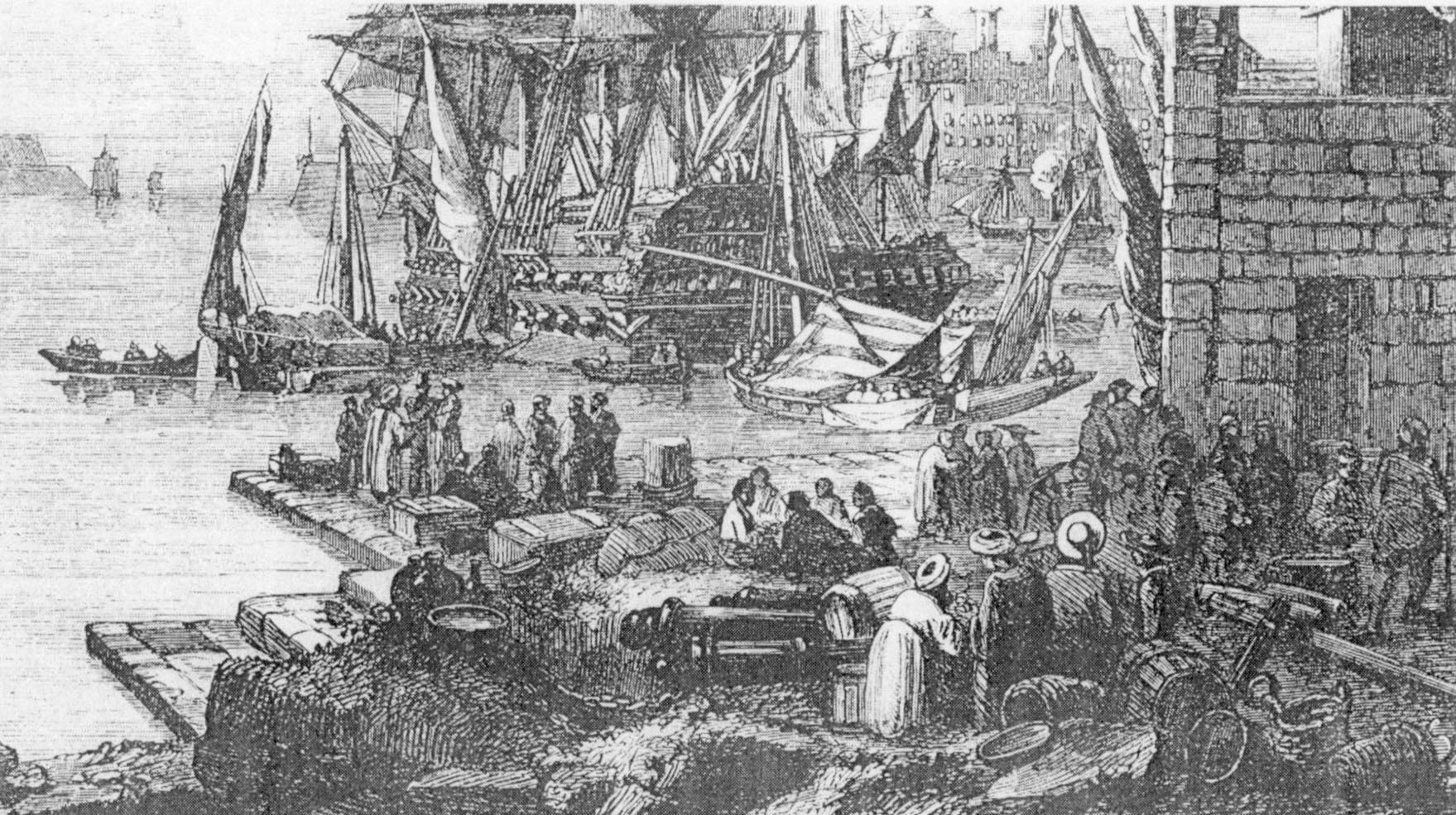
Maltese merchants waiting on the quay of Ras Hanzir, ready to embark for Mediterranean ports
Text published with the kind permission of Aurore VERIE
- Economic life in Malta in the 18th century, Aurore Verié
- Foreigners in Malta (late sixteenth and seventeenth centuries), Anne Brogini
- The Maltese language, a linguistic crossroads, Martine VANHOVE
- The Jews in Malta, Aurore Verié
- The French in Algeria from 1830 to today (excerpts), Jeannine VERDES-LEROUX
- The emigration of Maltese in Algeria in the nineteenth century, Marc DONATO
- Malta in "A Winter in Egypt" (excerpts), Eugène Poitou
- The Maltese in Tunisia before the Protectorate (excerpts), Andrea L. SMITH
- The population of Malta in the seventeenth century, a reflection of modernity (excerpts), Anne Brogini
- The fear of the French Revolution in Malta, Frans CIAPPARA
- The Siege of Malta by Napoleon Bonaparte (excerpts)
- Malte, frontière de chrétienté (1530-1670), de Anne BROGINI
- L'esclavage au quotidien à Malte au xvie siècle, de Anne BROGINI
- Noblesse maltaise et généalogie, de Loïck PORTELLI
- Some Disreputable Maltese, by Loïck PORTELLI